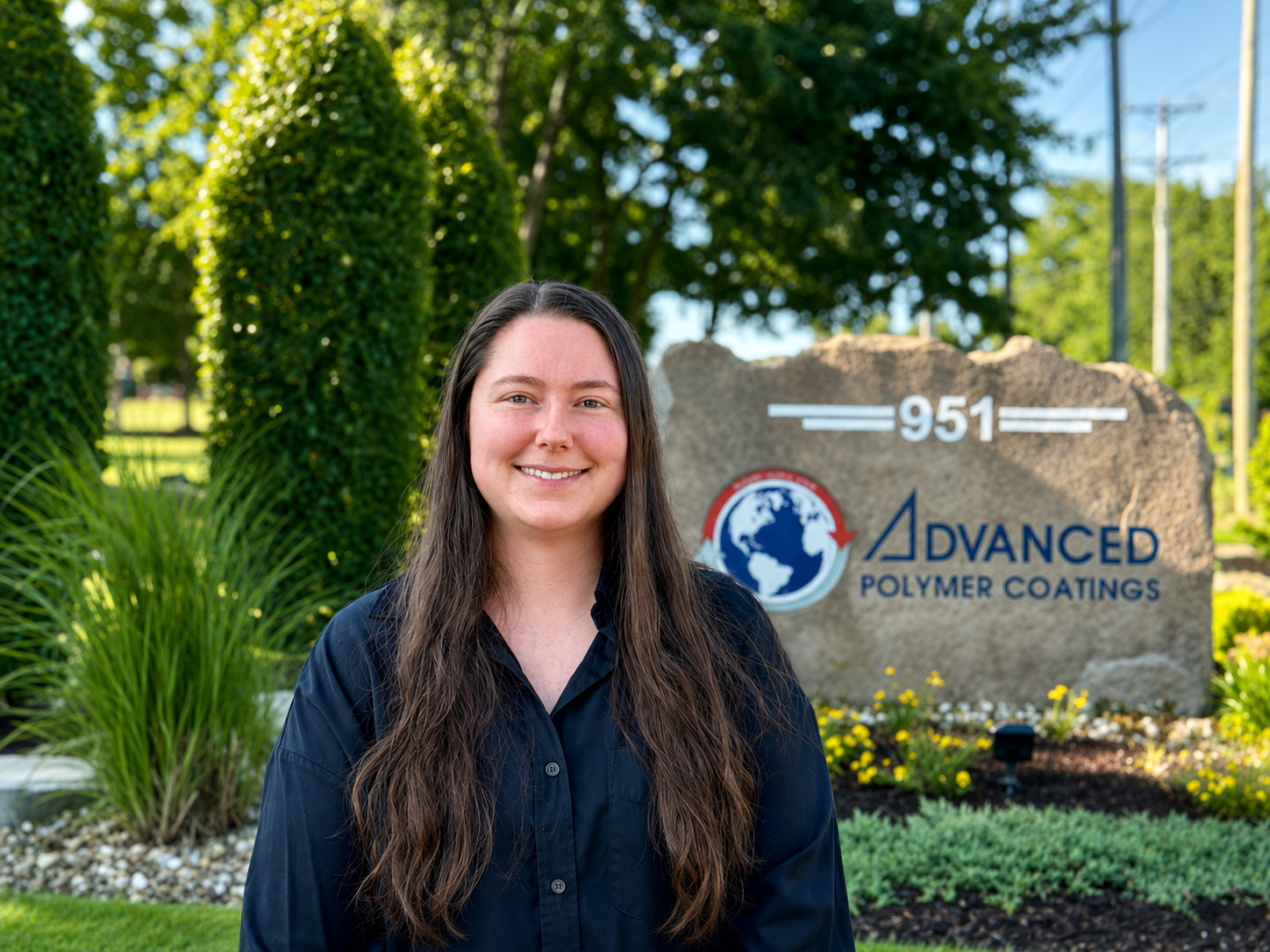
Digital transformation usually starts in the C-suite. A leadership team sets a mandate, budget gets allocated, and the initiative rolls downhill to the people doing the work. At Advanced Polymer Coatings (APC), it happened the other way around: Jenna Wagner, a senior R&D chemist, saw the shift coming and decided to build the foundation herself, one lab notebook entry at a time.
Today, that foundation has become the operating system for how APC's scientists work, and the company is now scaling its use as their R&D team grows.
Building for scale in a rigorous industry
APC is a global leader in polymer coatings, specializing in high-performance protective coatings for some of the toughest jobs in industrial chemistry: tank linings that protect ships, railcars, and storage tanks carrying aggressive, hazardous chemicals from one place to another. Their customers require coatings that can protect assets in every situation, ensuring longer lining lifecycles, efficiently operating fleets, and less maintenance time.
The company is in the middle of a serious growth push, expanding its facility and adding new lab, testing, and production capacity to continue meeting demand. APC’s R&D team, responsible for developing and refining APC's coatings from first formulation through final testing, is at the heart of this expansion. When Jenna joined the company, the R&D team ran entirely on paper lab notebooks, Excel files, Word documents, and shared drive folders. It worked, but it was far from ideal for a team innovating solutions for some of the most technically rigorous applications in the industry and preparing for a phase of growth.
Seeing the AI wave before it arrived
Jenna was paying attention to where the industry was headed and knew that there a shift towards AI in R&D. "I was definitely hearing a lot about AI and how it was coming into the industry, and I felt that we really needed to get on that wave on the earlier side, so we weren't behind," she said.
Beyond that, she also understood that there was more to modernizing R&D than jumping straight to AI pilots. "I knew that in order to be successful, you had to have good data management and structured data. We did not have that," she said. "So, I wanted to get that ball rolling."
She wasn't even searching for AI tools at first, just a traditional electronic lab notebook (ELN) to replace the patchwork of paper and spreadsheets. She screened several options before landing on Albert, drawn to its depth in coatings chemistry, the team’s willingness to parter closely with APC to understand their workflows, and a foundation that went beyond just an ELN or LIMS and could connect systems and augment scientist expertise with AI.
A single home for the day's work
Ask Jenna what her day looks like now and the answer is simple: Albert is the first thing she opens after email, and it stays open all day. "I don't have a lab notebook anymore," she said. "I use it for everything. It's kind of like a to-do list combined with my formulations."
But the bigger shift has been what it did for the team, not just her own workflow. Before, when she and a colleague needed visibility into each other's work, they had to ask or dig through someone else's files to find it. Now it's all in one searchable place. "It's kind of a historical database," she said. "Everything we need is in there somewhere, and it's not lost."
That's a meaningful shift for a company built on decades of formulation knowledge, which now compounds instead of living in scattered notebooks vulnerable to being lost when someone moves on.
The biggest hurdle to adoption, Jenna admits, was herself. "The way I formulate, I had to break my habit of just writing down my chicken scratch in my little side notebook," she said. It's a habit she's since broken for good, once she saw where the data needed to go and how much value having a strong data foundation would bring to her work.
Cutting development timelines in half
That foundation is already paying off for APC. Using Breakthrough, Albert's suite of AI/ML tools trained on APC's own structured data, the R&D team can narrow formulation problems down to as few as five to eight experiments then use the optimization tool to land on strong candidates, instead of having to guess at a new formulation from scratch. It’s cut their overall development time roughly in half.
"I think it's a competitive advantage," she said. "We're such a small team that we can double ourselves and iterate faster through Albert."
Building the foundation for what's next
APC's R&D team is about to grow, and Jenna, without really planning to, has become the internal champion who makes it possible for new chemists to onboard onto structured workflows instead of the patchwork she once inherited.
Having spent the past year and a half laying that foundation, Jenna is about to start a new project, and for the first time, she gets to spend less of it managing data and more of it just inventing. That's the beauty of the foundation she built: less time wrestling with where things live, more room to chase an idea and see where it goes. "I'm really excited for my next project," she said.
It's a fitting next step for someone who saw the future of R&D coming before anyone asked her to, and built the groundwork for it herself, from the bench.

.png)




“Albert is fundamentally changing the way we have invented for over 145 years.”

.svg)
.png)